A decade-long experiment to weigh gravity just deepened a 225-year-old mystery
Gravity is the force we meet first — it’s what holds you in your chair. Yet the number that sets its strength, the gravitational constant known as “big G,” is the most poorly measured of all the fundamental constants in physics. After more than 225 years of trying, scientists still know G to only about three significant figures. A new decade-long experiment at the U.S. National Institute of Standards and Technology set out to finally pin it down — and instead made the puzzle worse.
Why one number is so stubborn
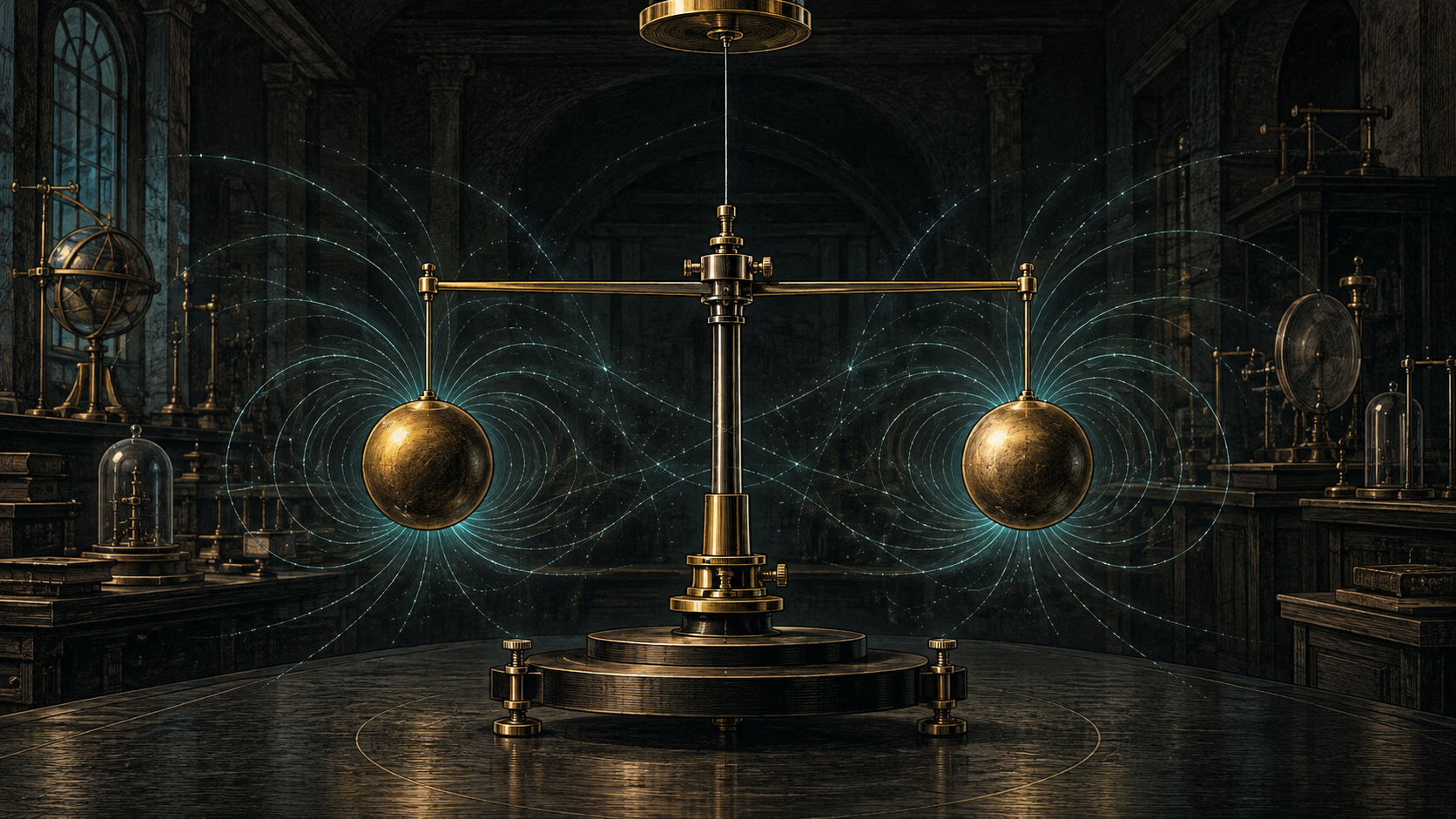
G is the constant in Newton’s law of gravity: it tells you how strong the pull is between two masses. The trouble is that gravity is fantastically weak compared with the other forces of nature, so measuring G means detecting the almost imperceptible tug between metal weights in a lab while screening out everything else. The basic apparatus hasn’t changed in spirit since Henry Cavendish first did it in 1798: a torsion balance, where masses hang from a fine fiber and their tiny gravitational attraction twists it by a hair.
The NIST team, led by physicist Stephan Schlamminger, spent roughly ten years refining this idea — using eight cylindrical metal masses and carefully balancing gravitational torque against a measurable electrostatic one — to measure G more precisely than almost anyone before.
The sealed envelope
Here’s the part that makes this a genuinely good scientific story. To keep themselves honest, the team ran a “blind” analysis. A colleague, Patrick Abbott, subtracted a secret number from the experiment’s mass measurements, so that for years the researchers were working with data deliberately offset from reality. The correction needed to recover the true answer was literally sealed inside an envelope.
The point of that ritual is to defeat one of the sneakiest problems in precision physics: unconscious bias. If you can see your running answer, it’s terribly tempting — even for careful, honest people — to keep tweaking until it lands near the value you expected. By hiding the real number until the analysis was finished and frozen, the team made sure they couldn’t nudge their result toward anyone else’s. Only at the end did they open the envelope and see where they’d actually landed.
Where they landed
The new NIST value came out to G = 6.67387 × 10⁻¹¹ in the standard units — and it sits 0.0235% lower than the value from a leading 2007 experiment in France. That gap sounds microscopic, but for a fundamental constant measured this carefully on both sides it’s uncomfortably large: two of the most meticulous experiments ever performed disagree by more than their stated uncertainties allow.
So which is it — a mistake, or a message? The honest answer, and the one the researchers lean toward, is that an unaccounted-for experimental error is still the more likely culprit. Something subtle in one setup or the other is probably nudging the number. But nobody can point to it, and that’s exactly what keeps the mystery alive: after decades of increasingly sophisticated measurements, the world’s best G experiments still refuse to converge on a single value.
Why it matters
It’s tempting to shrug at a disagreement in the fourth decimal place. But G is not a detail — it’s woven into everything from the mass of the Earth to models of the cosmos, and it’s the one fundamental constant we know far worse than the rest. Every other force of nature has been pinned down to exquisite precision; gravity, the most familiar of them, remains the holdout.
There are really only two ways this ends. Either someone eventually finds the hidden systematic error and the values quietly snap into agreement — the boring, most-likely outcome — or the stubborn refusal to converge is telling us something we don’t yet understand about gravity itself. The NIST result doesn’t settle that. What it does, with the discipline of a sealed envelope, is make sure the disagreement is real and not wishful thinking — which is the necessary first step before anyone can figure out what it means.
The work was published in the journal Metrologia.
Sources: The NIST experiment led by Stephan Schlamminger, the sealed-envelope blind analysis (Patrick Abbott’s secret offset), the new value (6.67387 × 10⁻¹¹) and its 0.0235% gap below the 2007 French measurement, the torsion-balance/eight-masses method, the 225-year history since Cavendish, G known to ~3 significant figures, and the error-vs-new-physics framing, published in *Metrologia*: Scientists opened a sealed envelope after 10 years. Gravity still didn’t make sense — ScienceDaily.
NIST’s own account of the measurement: NIST weighs in on the mystery of the gravitational constant — NIST.
We use AI in our daily operations; posts are reviewed by people before publishing; automated/generated posts are marked as such where needed.