EU Blue Card in Romania in 2026: salary threshold, requirements, process and benefits
The EU Blue Card is the residence permit Romania gives to highly qualified workers from outside the EU, such as IT specialists, engineers, doctors and managers. In 2026 the way to get one changed: an online application replaced the old work authorisation, and part of the new platform has been frozen since September. This guide sets out what Romanian law says as of 21 October 2026. It is general information, not legal advice.
The legal basis
The Blue Card is regulated by Emergency Ordinance (OUG) 194/2002 on foreigners. Article 2 defines it as a document issued by the General Inspectorate for Immigration (IGI) confirming the holder’s right to stay and work as a highly qualified worker. Romania transposed the current EU rules, Directive (EU) 2021/1883, through Law 28/2024 of 29 February 2024 (Official Gazette no. 176, 5 March 2024). OUG 32/2026, published on 27 April 2026, then moved hiring onto the WorkinRomania.gov.ro platform. It also repealed Title I of Government Ordinance 25/2014, the basis of the old work authorisation.
The 2026 salary threshold
Romanian law requires a salary of at least the average gross earnings (câștigul salarial mediu brut), so the multiplier is 1 (Articles 27^1 and 56 of OUG 194/2002, wording introduced by Law 28/2024). The EU directive lets each country choose between 1 and 1.6 times its average gross salary, according to the EU Immigration Portal. Romania uses the lowest point.
The law does not say which official average applies. Two official figures exist for 2026:
- 9,192 lei a month. Article 19 of Law 44/2026 on the 2026 state social insurance budget (27 March 2026) sets the average gross earnings used for that budget at 9,192 lei.
- 9,497 lei a month. This is the National Institute of Statistics (INS) average gross wage for August 2026, published on 13 October 2026. It changes monthly.
We found no IGI or WorkinRomania page stating which figure applies to Blue Card files in 2026. An offer at or above the higher figure avoids the question; employers should confirm with IGI. For comparison, the national minimum gross wage is 4,325 lei from 1 July 2026 (Government Decision 146/2026), so the threshold is a little over twice the minimum.
Who qualifies
The contract must be full-time, permanent or fixed-term for at least 6 months (Article 27^1(3)). The worker must show “higher professional skills” in one of two ways:
- A degree: a recognition document for foreign studies from the Ministry of Education and Research, or a Romanian higher-education diploma.
- Experience: generally at least 5 years at a level comparable to higher education. ICT managers and specialists need 3 years of relevant experience within the 7 years before applying (Article 27^1(6)-(7)). The law’s document rule for this route refers to skills gained in Romania, the EU, the EEA or Switzerland and to regulated professions, so applicants with experience from elsewhere should ask IGI how it will be assessed.
The employer must also upload a certificate on available labour from the county employment agency, issued no more than 90 days earlier. It must not exist mainly to bring foreigners into Romania (Article 56(16)). Highly qualified applicants do not have to prove 90 days of means of support at the visa stage. The annual quota limits only the D/AM2 visa for ordinary workers (Article 44(6)), not this route.
How the process works in 2026
1. The employer registers on WorkinRomania. The National Employment Agency (ANOFM) answers within a maximum of 30 working days, according to OUG 32/2026.
2. The employer files a single application for a D/AM1 visa. It uploads the contract registered in REGES-ONLINE, travel medical insurance of at least EUR 30,000, a criminal record certificate (translated into Romanian, English or French and legalised), a passport copy, a CV with the diploma recognition or proof of experience, and the labour availability certificate. IGI, and the Education Ministry where relevant, must finish their checks within 30 days (Article 44(10)).
3. The worker applies for the visa in person at the Romanian embassy or consulate. It is decided within 30 days of that appearance (Article 44(14)). The visa is first valid for 90 days, according to WorkinRomania.
4. The worker applies for the Blue Card at the local IGI office, at least 30 days before the visa’s right of stay ends. The file includes the passport, a medical certificate, proof of housing, health insurance and fee receipts (Article 51). IGI decides within 30 days, extendable by 15, or by up to 30 in complex work cases. The card runs for the contract plus 3 months, up to 3 years, and is renewable (Article 56(3)).
The suspension. On 21 October 2026, a WorkinRomania notice said employer registration, employer authorisation and D/AM2 applications were disabled. This followed a Bucharest Court of Appeal decision suspending Order 1073/2026, the shortage-occupation list. The notice does not mention D/AM1, but registration is the first step, so an employer not yet on the platform may be unable to start. See our guide Romania work permit in 2026: how hiring a non-EU worker works now.
Fees
- Long-stay visa: EUR 300 for e-Visa applications from 27 April 2026, according to the Ministry of Foreign Affairs (EUR 120 before).
- Residence permit: IGI’s fee sheet lists a EUR 120 consular fee (paid in lei) plus 265 lei for the card.
Insurance, translations, legalisation and the criminal record certificate cost extra and vary by country.
Family reunification
Blue Card holders can apply for family reunification even if their permit runs for less than a year (Article 46(6)). They can file it at the same time as the Blue Card application, and both are decided together (Article 46(6^1)). The general conditions still apply, including suitable housing and means equal to the minimum gross wage per family member for 3 months, on top of the holder’s own (Article 46(9)). Family members can work on their permit (Article 132^1). See Family reunification in Romania in 2026: visa, residence permit and documents.
Changing employer or losing the job
A holder can change employer by resigning after at least 6 months with the previous employer, counted from the start date in REGES-ONLINE, or sooner after a serious breach by the employer (Article 56(13)-(14)). The new employer files a single application on WorkinRomania; once approved, the worker books an IGI appointment within 10 days. Unlike D/AM2 workers, Blue Card holders do not need a placement agency to switch.
If the job ends, the right of stay continues while unemployment benefit is paid, or for up to 90 days from the registered end of the contract. A new contract in that time keeps the card valid (Article 56(6)-(7)). IGI can revoke the card after more than 3 months of unemployment in total for holders of under 2 years, or more than 6 months after that (Article 77(4)).
Moving within the EU
- Business trips into Romania: a holder of another member state’s Blue Card can come for meetings, conferences, negotiations, sales or training for up to 90 days in any 180 (Article 56^4(1)-(3)).
- Moving to Romania: after 12 months in the first member state, or 6 months in a second, the holder can live and work in Romania on that card. They must apply for a Romanian Blue Card within one month, with a contract of at least 6 months at the average gross wage and a recognised degree (Article 56^4(4)-(5)).
- Moving on from Romania: the destination country’s rules apply. The EU Immigration Portal says holders can move after 12 months. Romania cannot revoke the card while the other state decides (Article 77(5^1)).
The path to long-term residence
Article 71(5) grants long-term residence after 5 years of continuous legal residence in the EU, EEA or Switzerland as a Blue Card holder, researcher, student or protection beneficiary, with the last 2 years in Romania on a Blue Card. Absences may not exceed 12 consecutive months or 18 months in total, more generous than the general 6 and 10 months. Means at the minimum gross wage for 12 months, health insurance, housing, satisfactory Romanian and a clean record are still required. See Permanent residence in Romania in 2026: requirements, rights and the golden visa myth, including the language certificate required from 2027.
Blue Card or ordinary work permit?
For a qualified worker offered at least the average gross wage, the Blue Card is the route. Compared with the ordinary D/AM2 route, it brings:
- no quota and no shortage-list requirement
- a card valid for up to 3 years, against 2 for ordinary work (Article 56(2))
- family reunification filed alongside the card
- employer changes without an agency
- EU mobility and EU-wide time towards long-term residence
The price is a salary of roughly twice the minimum wage, recognised qualifications and stricter unemployment limits. Anyone paid less must use D/AM2, which needs a shortage-list occupation and is currently suspended. Gross-to-net figures are in Minimum salary in Romania in 2026: gross, net and what foreign workers take home.
Common pitfalls
- Outdated pages. The EU Immigration Portal’s Romania page (dated 1 April 2025) still describes the old work authorisation, “four times” the average gross wage and a two-year maximum.
- Gross versus net. The threshold is gross pay.
- Late diploma recognition. Start it early.
Documents that need certified translation
Diplomas, transcripts, employer letters, criminal record certificates and family civil-status documents usually need certified translation plus an apostille or legalisation. Romanian authorities generally want the translation notarised (traducere legalizată), not just certified.
Sources: Blue Card definition, salary rule, qualifications, visa and permit deadlines, validity, family, employer change, unemployment, mobility, long-term residence (Articles 2, 27^1, 44, 46, 51, 56, 56^4, 71, 77, 132^1); transposition by Law 28/2024: Ordonanta de urgenta nr. 194/2002, forma consolidata – Portal Legislativ (Ministerul Justitiei), version of 27 April 2026.
D/AM1 single application, ANOFM deadline, employer change, repeal of OG 25/2014 Title I: Ordonanta de urgenta nr. 32 din 23 aprilie 2026 – Portal Legislativ (Ministerul Justitiei), 27 April 2026.
Average gross earnings of 9,192 lei: Legea nr. 44 din 27 martie 2026 a bugetului asigurarilor sociale de stat pe anul 2026 – Portal Legislativ (Ministerul Justitiei), 27 March 2026.
INS average gross wage of 9,497 lei: Castigul salarial mediu lunar, august 2026 – Institutul National de Statistica, 13 October 2026.
Minimum gross wage of 4,325 lei: Hotararea nr. 146 din 12 martie 2026 – Portal Legislativ (Ministerul Justitiei), 13 March 2026.
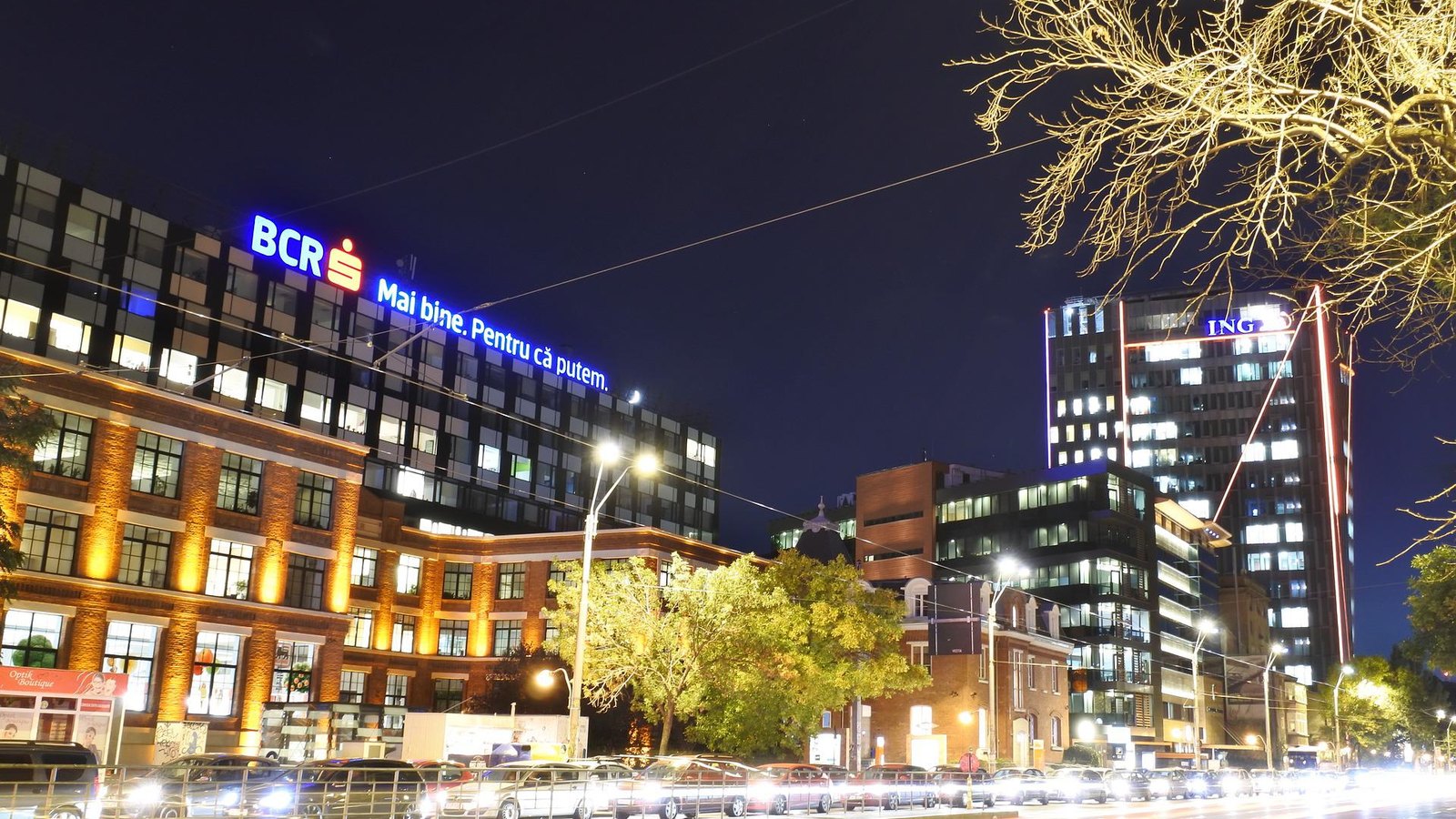
Header photo: Bucharest in the evening by Costin Halmagyi, CC0, via Wikimedia Commons, cropped.
We use AI in our daily operations; posts are reviewed by people before publishing; automated/generated posts are marked as such where needed.