Best cities in Romania for foreigners in 2026: where to visit or live
Romania’s cities split into clear lanes for arrivals from abroad: a capital with the deepest job market, a Transylvanian tech hub, a western industrial centre riding 2023 cultural-capital momentum, a walkable medieval town, a Carpathian base with a fast-growing airport, and a Black Sea port built around its beach season. Below is what current data says about six of them, with every figure attributed to the tracker or outlet that published it.
Bucharest: the job market and the transport hub
Bucharest is the only Romanian city with a legacy international airport network and the deepest salary base. Romania’s National Institute of Statistics put the municipality’s estimated population at 1,709,458 as of 1 January 2025, per data compiled by citypopulation.de from the institute’s figures — a city-proper number excluding the wider metro area, which runs well above two million counting Ilfov county’s commuter towns.
Cost is the trade-off. Numbeo’s cost-of-living page for Bucharest, last updated October 18, 2026, lists a one-bedroom apartment in the city centre at 3,241.62 lei a month (range 2,500–4,252 lei) and the same unit outside the centre at 2,127.84 lei — central rents roughly 52% higher. On Numbeo’s 2026 Eastern Europe cost-of-living index, Bucharest posts the highest score of any Romanian city, 46.3, ahead of Cluj-Napoca’s 44.6 and Brașov’s 43.7: the widest range of jobs and flights, but the steepest everyday prices too.
Cluj-Napoca: the tech-sector counterweight
Cluj-Napoca is Transylvania’s largest city and Romania’s second economic centre, built around a large student population anchored by Babeș-Bolyai University, according to Wikipedia’s summary, which cites 286,598 residents in the city at the 2021 census and, separately, a 411,379 metro-area figure from 2011. The city joined UNESCO’s Creative Cities Network and was named a UNESCO City of Film in 2021, a tag that still anchors its cultural branding.
On Numbeo’s 2026 regional index, Cluj-Napoca is Romania’s second most expensive city to live in at 44.6 against Bucharest’s 46.3 — a gap narrowed by software and shared-services salaries pushing local rents up. For anyone weighing a move rather than a visit, that narrowing cost gap against a smaller population base is the city’s defining 2026 story.
Timișoara: industrial depth and a cultural-capital afterglow
Timișoara, Romania’s fifth most populous city with 250,849 residents at the 2021 census per Wikipedia, carries two identities. It was the country’s second European Capital of Culture in 2023, a designation that left legacy programming — a new concert hall, extended exhibitions — running into 2025, per Romania-Insider and the Timișoara 2023 programme archive.
Separately, its IT sector employs an estimated 19,000-20,500 professionals, Romania’s third-largest tech hub at roughly 11-12 percent of the country’s IT workforce, per a 2026 labour-market analysis from recruitment platform Kitalent. That analysis found headcount growth slowing to 3.2 percent year-on-year through 2024, down from 12-15 percent in 2021-2022, with local universities producing 2,800-3,200 IT graduates a year, only 40-45 percent of whom stay rather than moving on. On Numbeo’s 2026 index, Timișoara scores 41.3, cheaper than Bucharest, Cluj-Napoca, Brașov, and Constanța.
Sibiu: the walkable medieval base
Sibiu is the compact option here: a fortified medieval centre with 134,309 residents at the 2021 census, per Wikipedia. Its historic core has sat on Romania’s tentative UNESCO World Heritage list since 2004, not yet formally inscribed, while several nearby fortified villages already hold full UNESCO status. The city was European Capital of Culture in 2007, and tourism has remained an economic pillar since. On Numbeo’s 2026 cost index, Sibiu is the cheapest city covered here, 38.6, well below Bucharest and Cluj-Napoca.
Brașov: the mountain base with a fast-growing airport
Brașov’s 2026 case is about air access. Brașov-Ghimbav International Airport, opened June 2023, carried 227,900 passengers in 2024 and had already reached 337,353 with 3,496 aircraft movements through 2025, per Wikipedia’s traffic figures. Wizz Air is the driver: it added Memmingen, Katowice, and Naples in 2025, and is now opening its tenth Romanian base there, stationing an Airbus A321neo from December 2026 and launching four routes — Chișinău, Barcelona, Karlsruhe/Baden-Baden, and Madrid — between December 17 and 20, 2026, per aviation outlet Aviation A2Z, which reported the airline has carried over 800,000 passengers out of Brașov since August 2023. On Numbeo’s index, Brașov scores 43.7, Romania’s third most expensive city here.
Constanța: the Black Sea option
Constanța is Romania’s main seaside city and principal Black Sea port, home to the largest port on the Black Sea and one of Europe’s larger cargo ports by tonnage, according to Wikipedia. Its population stood at 263,688 at the 2021 census, a decline from the previous count. It is served by Mihail Kogălniceanu International Airport and linked to Bucharest by rail since 1895. Its beach season, centred on the adjoining Mamaia resort, draws the country’s largest domestic tourist flow: industry body OMD Mamaia-Constanța reported in September 2025 that the summer season brought a significant tourist-flow increase, helped by new attractions including the Scena Arlecchino stage and the Dino Rex Park, though final visitor numbers were deferred to a later release. On Numbeo’s 2026 index, Constanța scores 43.4, on par with Brașov.
What the numbers suggest for 2026
Taken together, the data points to a simple split. Bucharest and Cluj-Napoca carry the highest costs and the deepest job activity, the default choices for relocating for work. Timișoara offers a comparable tech base at a lower cost score. Sibiu and Brașov suit shorter visits or a slower-paced move, with Brașov’s airport expansion narrowing the access gap. Constanța remains a seasonal, seaside-specific pick rather than a year-round base. None of the figures above are a personal budget — rents vary by street and season, and the cost-index scores are city-wide averages, not a quote for any lease or flight.
Sources: Rent and cost-of-living index for Bucharest: Cost of Living in Bucharest, updated October 18, 2026.
2026 regional cost-of-living index ranking all cities: Eastern Europe: Cost of Living Index by City 2026.
Bucharest population estimate (INS data): București (City, Romania) — Population Statistics.
Brașov airport passenger traffic and route history: Brașov–Ghimbav International Airport.
Wizz Air’s new Brașov base and 2026 routes: Wizz Air Expands in Romania, Opens Brasov Base.
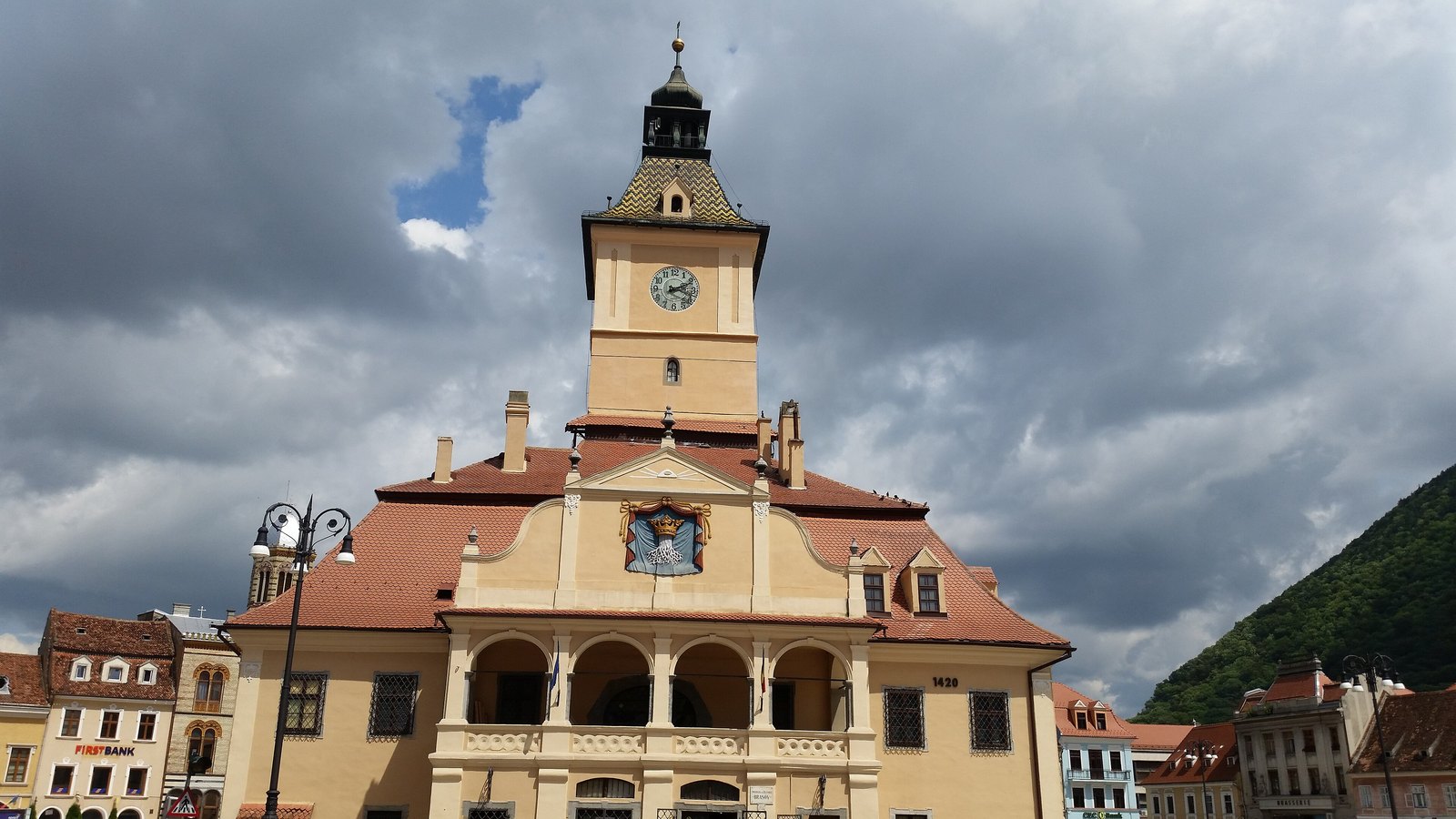
Header photo: Casa Sfatului, Brașov 03 by Nenea hartia, CC BY-SA 4.0, via Wikimedia Commons; this crop is released under the same licence.
We use AI in our daily operations; posts are reviewed by people before publishing; automated/generated posts are marked as such where needed.