Oil has cooled from its September highs, but the US government just raised its price forecast
Crude oil has drifted lower over the past week and a half, but the US Energy Information Administration is not treating that as the start of a slide. In its October Short-Term Energy Outlook, published on 6 October, the agency raised its oil price forecasts for both this year and next — and warned that households heating with oil should brace for noticeably bigger bills this winter.
Prices are off their peak, not falling apart
Brent crude, the international benchmark, settled at about $101.5 a barrel on 6 October, according to futures data from Yahoo Finance. That is roughly 6.7% below its September peak of about $108.8 on 15 September, after a slide of almost 2% on 5 October that was only partly recovered the next day. US crude (WTI) followed a similar path, settling near $90.2. Intraday headlines and closing prices did not always agree.
Why the EIA raised its forecast anyway
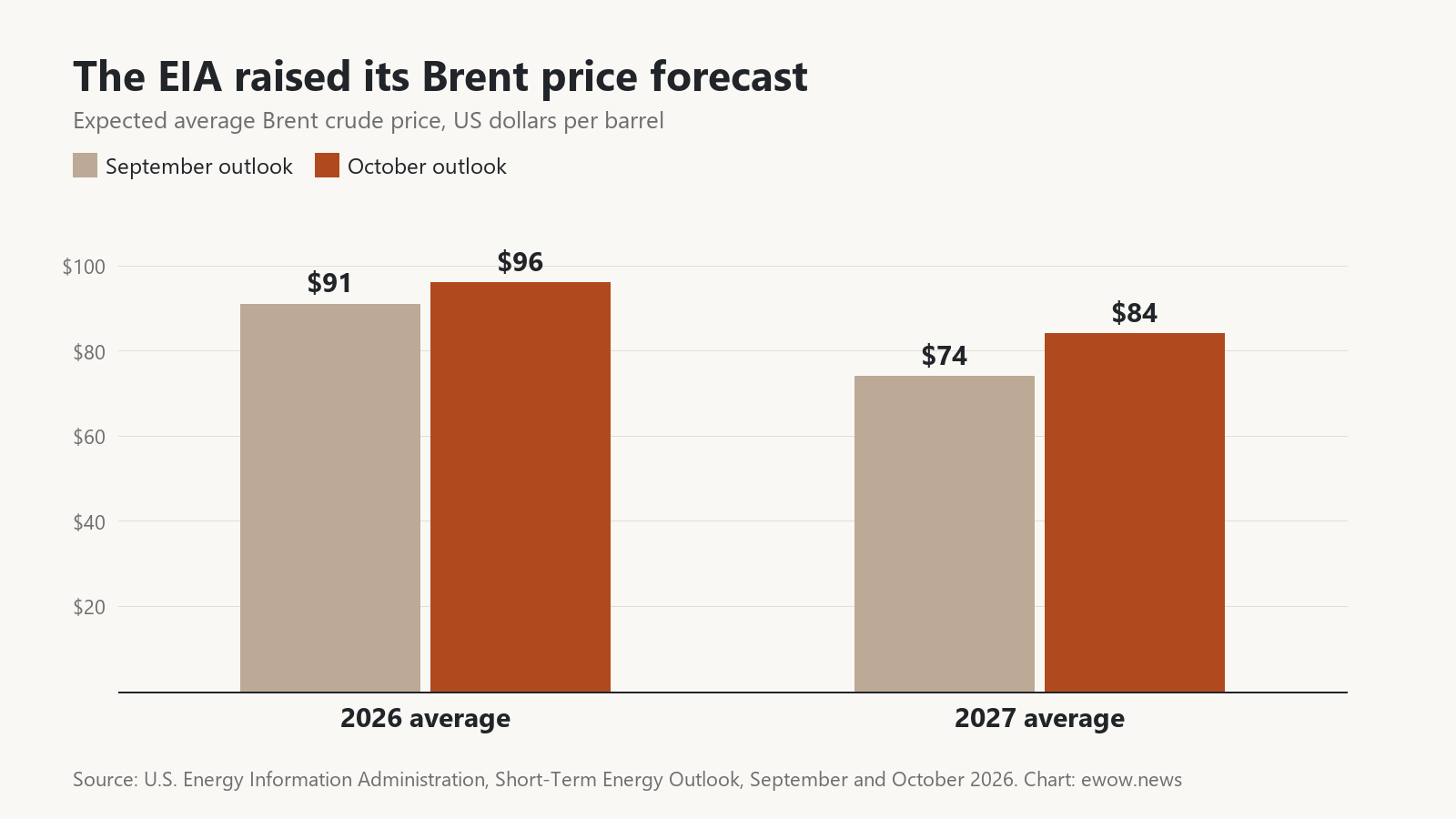
The EIA now expects Brent to average $96 a barrel in 2026, up 6% from the $91 it projected a month earlier, and $84 in 2027, up 14% from $74. Its reasoning rests on supply, not demand:
- Middle East flows stay constrained. The agency assumes oil flows from the region will remain limited through the fourth quarter, even though it estimates that shut-in production in September was the lowest since hostilities began — in other words, some supply is coming back, but not enough to relax the market.
- Infrastructure risk. The EIA points to attacks on the East-West pipeline in Saudi Arabia as a sign of “continued volatility in physical oil flows and oil prices.”
- A very tight diesel market. Extreme tightness in diesel, the agency says, raises demand for crude because refiners need more of it to produce enough diesel.
That combination explains why a short-term dip in prices did not change the agency’s view: the forecast is built on how much oil can physically reach the market over the coming months, and that picture has not improved enough.
What it means at the pump
US retail gasoline averaged $4.35 a gallon in September, according to the EIA, and the agency forecasts an average of $3.91 for 2026 as a whole and $3.56 for 2027. Diesel is where the strain shows most: it averaged $6.29 a gallon in September, with the EIA forecasting $5.19 for 2026 and $4.49 for 2027.
A split winter for household heating bills
The same day, the EIA published its winter fuels outlook, and the picture depends heavily on how a home is heated. Households using natural gas or propane — about half of US homes — are expected to spend less than last winter. Homes heated with electricity are expected to spend more. The sharpest increase falls on heating-oil households, about 3% of US homes and concentrated in the Northeast: the EIA expects them to pay about 21% more, and notes that some forecasts show heating-oil prices rising by more than 30%.
“Relatively high natural gas inventories entering the winter season provide a cushion for heating demand, while households that rely on heating oil face higher prices because distillate markets remain tight,” said EIA Administrator Tristan Abbey.
The agency assumes a winter about as cold as last year’s and close to the 10-year average, while noting that a strong El Niño could change both the weather and heating demand.
The bottom line
The recent dip in crude prices is real but modest, and the government’s own forecasters see it as noise around a market that is still short of physical supply — especially of diesel and heating oil. For consumers, that means relief at the gasoline pump is expected to continue gradually, while the Northeast’s oil-heated homes face the steepest bills of the winter.
Sources: The October 2026 Short-Term Energy Outlook (released 6 October 2026): Short-Term Energy Outlook — U.S. Energy Information Administration.
The winter fuels outlook (6 October 2026): EIA expects a mixed picture for winter fuel costs this year — U.S. Energy Information Administration.
Brent and WTI futures settlement prices (September – 6 October 2026, incl. the 15 September peak): Brent crude oil futures historical data — Yahoo Finance.
Header chart: ewow.news, from the U.S. EIA Short-Term Energy Outlook (September and October 2026 editions), as quoted in this article.
We use AI in our daily operations; posts are reviewed by people before publishing; automated/generated posts are marked as such where needed.