Driving in Romania as a foreigner in 2026: licenses, IDPs and exchange rules
Foreigners driving in Romania fall into a few distinct categories under Romanian traffic law: holders of licenses issued by EU/EEA member states, holders of UK-issued licenses, and holders of licenses from other “third countries,” including the United States and Canada. Each group is treated differently, and the rules determine whether an International Driving Permit (IDP) is needed alongside the original license, and when — or whether — the license must eventually be exchanged for a Romanian one.
EU and EEA licenses
A driving license issued by any EU or EEA country can be used in Romania without any formality or exchange, according to the European Commission’s “Your Europe” portal, which states that “if your licence was issued in an EU country, you can use it anywhere in the EU.” This holds whether the holder is visiting Romania or has taken up residence there — mutual recognition among member states means no swap is required simply because someone moves to Romania. Exchange becomes relevant only in narrower situations, such as when the original license expires (renewal must then happen in the country of usual residence) or is lost or stolen, the European Commission’s guidance says.
UK licenses after Brexit
A UK-issued driving license — including licenses from Gibraltar, Guernsey and Jersey — can still be used to drive in Romania without an IDP, according to Poliția Română, the Romanian national police. The police attribute this to the United Kingdom’s accession to the 1968 Vienna Convention on Road Traffic, which took effect on March 28, 2019, ahead of the UK’s departure from the EU. Romanian traffic law, cited by Poliția Română as Section 6, Article 83 of Government Emergency Ordinance 195/2002, recognizes licenses from states that are parties to the 1968 Vienna Convention, EU states, and states with bilateral reciprocity agreements with Romania. Poliția Română’s published guidance does not cite any deadline by which a UK license must be exchanged for a Romanian one.
UK license holders who settle in Romania can still swap without an exam: the UK has been on the Interior Ministry’s list of Vienna Convention states with exchangeable licenses since the Brexit transition period ended on December 31, 2020.
US, Canadian and other third-country licenses
Citizens of the United States, Canada, Australia and New Zealand who hold a license issued by their own country can drive in Romania without an IDP for up to six months from entry, and Chilean citizens for up to three months, provided they also carry their valid national passport, under Government Decision (Hotărârea Guvernului) no. 795/2025, published in the Official Gazette (Monitorul Oficial) no. 893 on September 30, 2025, according to Portal Legislativ, Romania’s official legislation database. The decision, dated September 25, 2025, applies to countries that are NATO or OECD members or Romanian strategic partners and that extend reciprocal recognition to Romanian licenses on their own territory. Holders of other foreign licenses need an IDP alongside the original only if the issuing state is neither an EU member, nor a party to the 1968 Vienna Convention, nor a bilateral-treaty partner of Romania; licenses from Vienna Convention states such as Ukraine, Moldova, Turkey or Israel are valid on their own, while US and Canadian drivers outside the HG 795/2025 conditions do need an IDP. Romania is a party to both the 1968 Vienna and the 1949 Geneva road traffic conventions, so the Geneva-format IDP issued in the US, Canada or Australia is accepted.
Exchanging a license
For residents settling in long-term, the exchange of a foreign license for a Romanian one runs through the Direcția Generală Permise de Conducere și Înmatriculări (DGPCI) — the authority formerly known as DRPCIV, whose website now redirects to DGPCI’s — via its county-level SPCRPCIV offices, according to Romania’s official public services portal, serviciipublice.gov.ro. Romanian law sets no deadline for the swap, since Article 83(3) of OUG 195/2002 says foreign licenses “may” be exchanged, but only licenses from EU/EEA states, Switzerland, Vienna Convention states and a short list of others (the US, Canada, Australia, Japan, South Korea, Egypt, Jordan, Lebanon and, for category B only, China) can be exchanged without an exam. Applicants submit an identity document, proof of domicile or residence in Romania, the original foreign license (with a legalized Romanian translation where required), a completed application form, and, if requesting a license with a new administrative validity period, a medical fitness certificate from an authorized Romanian medical unit. From 15 September 2026 the fee is 139 lei (it was 89 lei before), according to the DGPCI fee page; it can be paid online through ghiseul.ro. Our step-by-step guide to exchanging a foreign driving licence in Romania covers the documents, the exchange list and the booking system. Applicants present their file in person at the county office, and the new license is later delivered by mail. The legal basis cited by the portal is Government Emergency Ordinance 195/2002, Government Ordinance 83/2001 and Order 123/2013.
Holders of licenses that cannot be exchanged must pass the Romanian driving exam, which is open to residents and to people studying in Romania for at least six months, and foreigners can take the theory test on request in English, French or German under rules in force since July 2014.
Fines, cameras and penalty points
Romania enforces speed limits partly through fixed and mobile radar cameras, with penalties combining a monetary fine, expressed in fine points, and penalty points on the driver’s record, under Government Emergency Ordinance 195/2002, the road traffic code. Since July 1, 2026, one fine point (punct-amendă) has been worth 216.25 RON, up from 202.50 RON, because the law pegs it at 5% of the minimum gross salary, which the government raised to 4,325 RON a month. Under the traffic code, driving 10-20 km/h over the limit costs 2-3 fine points (432.50-648.75 RON) plus 2 penalty points; 21-30 km/h over costs 4-5 fine points (865-1,081.25 RON) plus 3 penalty points; and 31-40 km/h over costs 6-8 fine points (1,297.50-1,730 RON) plus 4 penalty points. Exceeding the limit by more than 50 km/h or 70 km/h can trigger 90-day or 120-day license suspensions, respectively, on top of the points, under the same code. Those error margins are not a roadside allowance, however: metrology norm NML 021-05 sets ±3 km/h for stationary radars and ±4 km/h for moving ones (3% or 4% above 100 km/h), and Romania’s High Court ruled in 2018 that they apply only when a radar is certified, not when a ticket is issued. Foreign-registered vehicles caught by fixed cameras are not exempt from these penalties, though enforcement against non-resident drivers depends in practice on cross-border information-sharing arrangements between Romania and the driver’s home country.
Drivers who have swapped to a Romanian license face one more rule: under Government Emergency Ordinance 7/2026, a traffic fine issued since late August 2026 and left unpaid for 90 days suspends the right to drive, at one day per 50 RON owed.
Sources: European Commission: Driving licence and car insurance validity in the EU.
Poliția Română: Informare privind recunoașterea permiselor de conducere britanice după Brexit.
Portal Legislativ: Hotărârea Guvernului nr. 795/2025.
Servicii Publice (Romania’s official government services portal, DGPCI/DRPCIV): Preschimbarea permisului de conducere străin cu document similar românesc.
Destine Broker: Fines and changes in the 2025 Romanian traffic code.
Official texts: OUG 195/2002 road traffic code, MAI Order 163/2011 on licence exchange, MAI Order 268/2010 on driving exams, ICCJ Decision 3/2018.
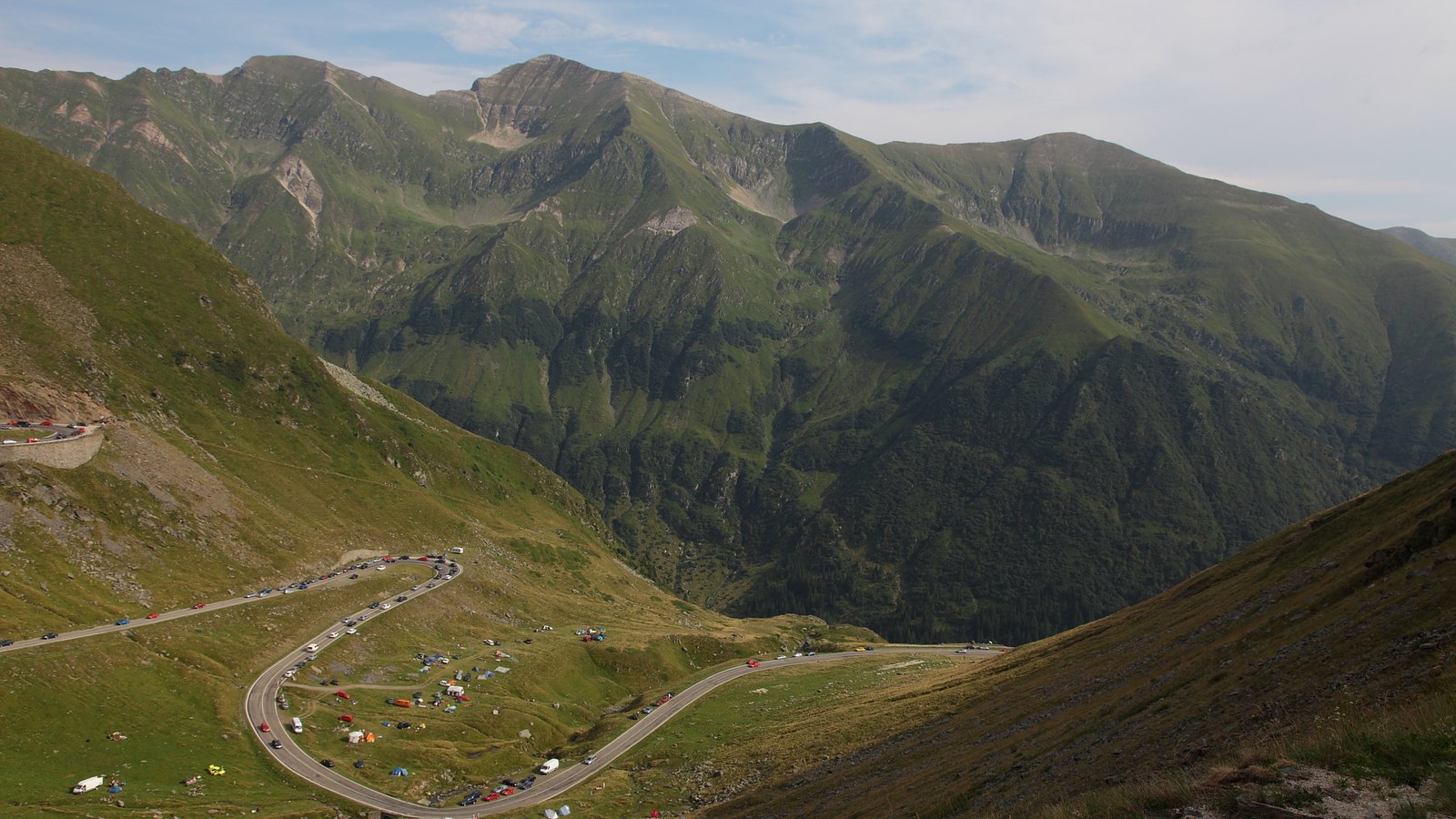
Header photo: Transfagarasan road by Mihaiteo, CC BY 3.0, via Wikimedia Commons, cropped.
We use AI in our daily operations; posts are reviewed by people before publishing; automated/generated posts are marked as such where needed.