How to register a car in Romania as a foreigner: documents, fees and where to go
Romania’s vehicle registry, the Direcția Generală Permise de Conducere și Înmatriculări (DGPCI, where drpciv.ro now redirects), estimates that its county offices processed 864,143 ownership transfers in 2024. Each took the same route: tax office first, then the Registrul Auto Român (RAR) if the car needs it, then the county registration counter. Here is what the official pages say.
Who can register, and where
The operation is done at the Serviciul Public Comunitar Regim Permise de Conducere și Înmatriculare a Vehiculelor (SPCRPCIV) of the buyer’s county of domicile, according to the Interior Ministry’s services portal. DGPCI’s document list adds that the ownership document must first be registered with the local tax office “at the domicile or registered office of the acquirer, or at their residence, in the case of individuals domiciled abroad”. A foreigner therefore needs a Romanian domicile or residence address on record first. The applicant presents a valid identity document in the original; anyone filing on their behalf needs a notarised special power of attorney or a lawyer’s mandate.
Step one: the local tax office
The ownership document has to carry a registration number in REMTII, the vehicle register kept by the local tax office, before DGPCI will accept it. Cluj-Napoca’s tax directorate lists what that step takes: tax declaration form 2016-ITL-005 for vehicles under 12 tonnes, the acquisition document (sale contract, invoice, inheritance certificate or “act of acquisition abroad”), the vehicle identity card (CIV) issued by RAR, and the owner’s identity document. If the sale contract lacks the seller’s tax office stamp, the seller’s tax clearance certificate is needed too. Copies are marked “Conform cu originalul”, and for documents in a language other than Romanian, the directorate says, copies translated into Romanian by an authorised translator are also filed.
Step two: RAR, if the car needs it
For a car already registered in Romania, DGPCI requires only a valid CIV and a periodic technical inspection (ITP) within its validity; its FAQ states that an RAR authenticity certificate is no longer required for a transfer between Romanian owners. RAR’s advice, in a press release of 11 November 2025, is to buy only after the seller has obtained the CIV, which the last owner is legally obliged to hand over, and to check that its data match the sale papers. An authenticity check on such a car is optional but, RAR says, recommended before paying.
For a car previously registered abroad, DGPCI requires a valid CIV, an authenticity certificate and a valid ITP, all from RAR, where the vehicle is presented with its original foreign registration certificate by appointment. Since 25 July 2022, RAR issues the CIV for a used EU vehicle only to the intra-community acquirer named in the purchase documents, which it scans and sends to ANAF. Customs and VAT are covered in ewow’s separate guide on importing a car.
Step three: the registration file
DGPCI’s list for transferring ownership of a Romanian-registered vehicle, updated 18 September 2026:
- the application form;
- the ownership document, original and copy, bearing the REMTII number;
- the applicant’s identity document, in the original;
- the CIV, in the original;
- the previous registration certificate;
- the previous plates, unless they transfer automatically to the new owner or the seller paid to keep the combination;
- proof of payment of the registration certificate (76 lei) and of the new plates, not needed when paid through ghiseul.ro;
- a copy of the RCA third-party insurance policy, in the owner’s name and valid.
A car previously registered abroad also needs the foreign registration documents in the original and the foreign plates, plus an ANAF certificate on VAT where the car comes from another EU state and the buyer is not VAT-registered. DGPCI says that certificate is not needed for vehicles bought in Romania or imported from outside the EU.
Fees and how to pay
DGPCI’s tariff page, updated 18 September 2026, puts the registration certificate at 76 lei, a provisional authorisation at 25 lei, and standard type A plates at 26 lei each, 52 lei a pair; keeping a number before selling costs 60 lei. The certificate and authorisation fees “can no longer be paid in cash at the counters”, DGPCI says: they go through ghiseul.ro, bank transfer, or BCR, CEC Bank and SelfPay terminals. Plates can still be paid in cash at the counter.
Appointments and delivery
Online appointments run through hub.mai.gov.ro, a pilot that lists Cluj, Ilfov and Timiș among its counties. Cluj’s prefecture says entry to the SPCRPCIV at Strada Traian Vuia 157 is allowed only with an online booking and the original identity document; bookings cannot be cancelled since 14 February 2025, but stay valid for two further working days. The Cluj registration counters open Monday to Thursday 8:00 to 21:00 and Friday 8:00 to 13:30.
After filing, a replacement proof can be issued on the spot, the certificate is posted, and the plates are collected at the office; in Bucharest and Ilfov the certificate is collected there too. The portal gives an average delivery of five working days and a maximum of 20 calendar days.
Temporary plates
If the car must move before the file is complete, the same office issues a provisional authorisation, the red plates, valid for up to 90 days. The file is the application, a copy of the RCA policy, the ownership document, the foreign registration documents for a car registered abroad, the identity document and proof of the 25 lei fee plus plates. Without the foreign papers, the authorisation is limited to five days. Exchanging a foreign licence is covered in ewow’s guide on driving in Romania as a foreigner.
Sources: Document lists (transfer, foreign-registered vehicle, provisional authorisation), REMTII rule, fees and payment (updated 18 September 2026): Documente și formulare – Înmatriculări – DGPCI.
Where to file, steps, delivery by post, Bucharest and Ilfov exception, delivery times, 2024 count (page updated 18 March 2025): Transcrierea dreptului de proprietate asupra unui vehicul – HUB servicii MAI.
Tax declaration form, acquisition documents, CIV, seller’s certificate, translation rule (page updated 25 May 2026): Taxe și impozite locale – Persoane fizice – Primăria Cluj-Napoca.
CIV hand-over obligation, authenticity certificate, buyer checks (press release, 11 November 2025): Atunci când cumperi un vehicul utilizat – Registrul Auto Român.
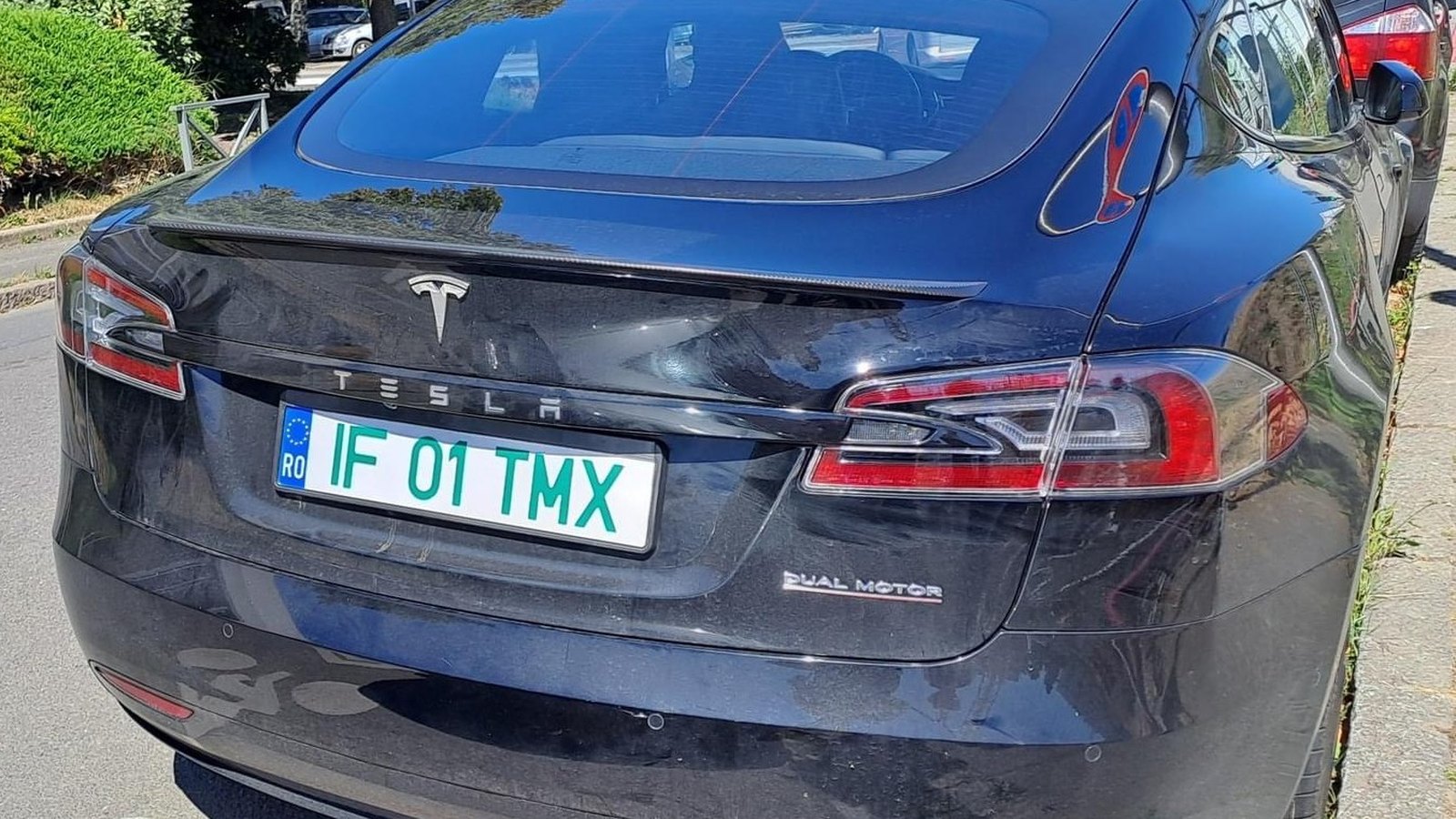
Header photo: Electric Romanian car license plate by Jean-Emmanuel Chevry, CC BY-SA 4.0, via Wikimedia Commons, cropped; this crop is released under the same licence.
We use AI in our daily operations; posts are reviewed by people before publishing; automated/generated posts are marked as such where needed.