Physicists just watched a single quantum of sound blink between states
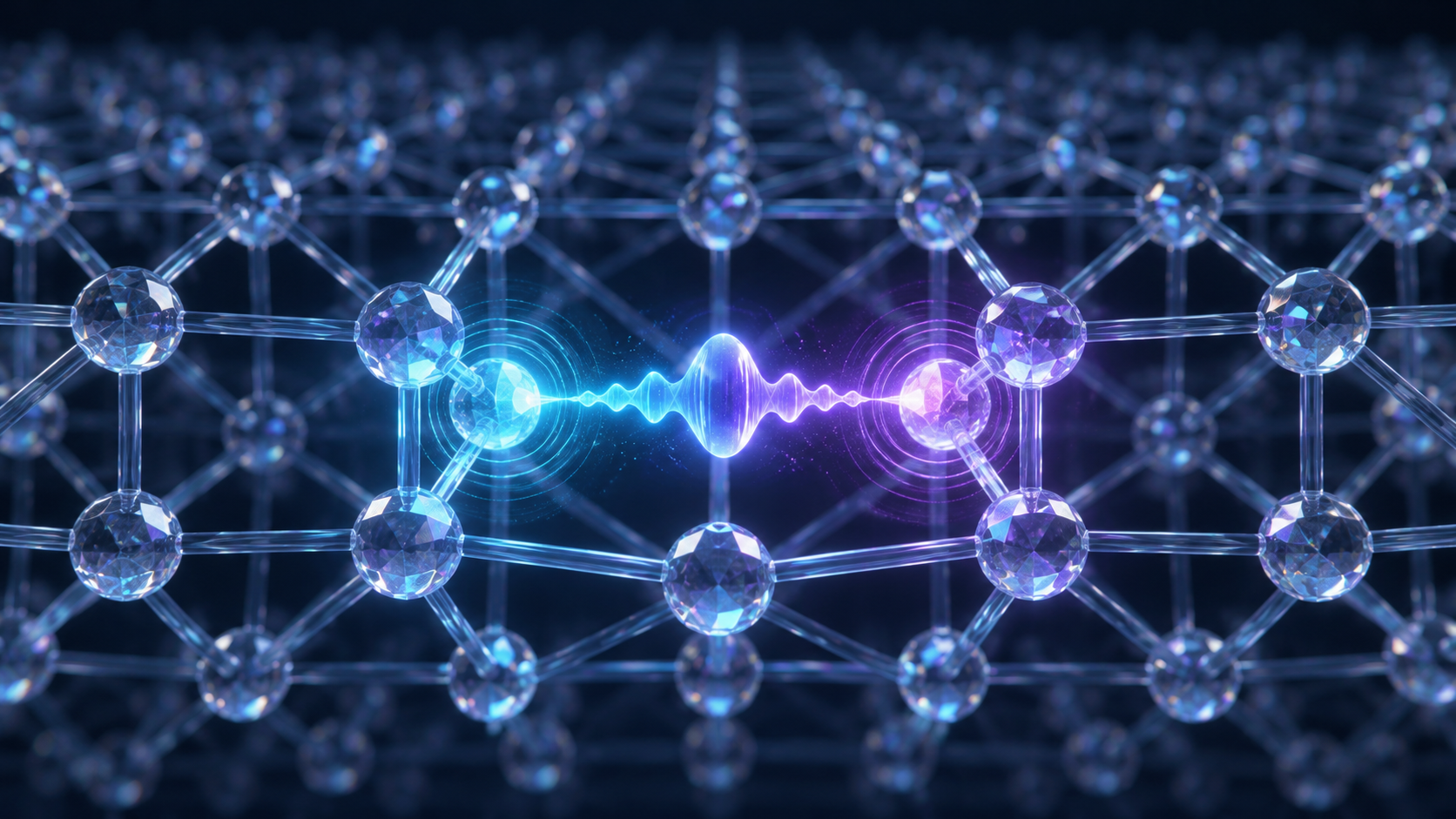
Sound, at its most fundamental level, comes in indivisible packets called phonons — the acoustic equivalent of the photon that makes up light. A single phonon is about as small as a vibration can get. Now, for the first time, physicists at Stanford have watched one of these smallest possible units of sound make a “quantum jump” in real time — abruptly flipping from one energy state to another, caught in the act.
What a quantum jump is
In the everyday world, things speed up and slow down smoothly. In the quantum world they don’t. A quantum system doesn’t glide between energy levels; it sits in one, then instantaneously jumps to another, with nothing in between. Niels Bohr predicted these discontinuous jumps a century ago, and they’ve become one of the strangest, most iconic features of quantum mechanics.
The trouble is catching one happening. A quantum jump is instantaneous and unpredictable, so seeing it requires watching a single quantum object continuously and fast enough to freeze the exact instant it flips. That’s why this has been done for only a handful of systems: quantum jumps were first observed in trapped ions in 1986, then in photons — particles of light — in 2007. Sound has now joined that very short list, in September 2026.
How you watch a phonon flip
The experiment, led by Amir Safavi-Naeini’s group at Stanford (with co-first authors Takuma Makihara and Erik Szakiel), rests on two clever pieces.
The first is a microscopic mechanical resonator — a tiny structure that can hold vibrational energy in discrete phonon amounts. Crucially, this resonator “rings” for an unusually long time: about two milliseconds. Two thousandths of a second sounds brief, but for a single quantum of vibration that’s an eternity, and it’s what makes the whole thing possible.
The second is the detector: a superconducting qubit coupled to the resonator, acting as a probe. During those two milliseconds of ringing, the qubit repeatedly checks the resonator — hundreds of times — to ask whether the phonon is present (an energy state of “1”) or gone (“0”), without immediately destroying the fragile quantum state it’s measuring. Stack up hundreds of these gentle peeks and you get a real-time movie of the phonon’s life, precise enough to pinpoint the exact moment it jumps.
Why it matters
Beyond the sheer strangeness of seeing sound behave this way, the result is useful. The work was published in the journal Science, and the payoffs cluster around two ideas.
The first is quantum error correction — the central engineering problem standing between today’s fragile quantum computers and reliable ones. Errors in a quantum machine are, at bottom, unwanted quantum jumps. Being able to detect a single jump the instant it happens, in a mechanical system, is exactly the kind of capability error correction is built on. Mechanical resonators are an attractive platform for storing quantum information, and watching their jumps directly is a step toward catching and fixing errors in real time.
The second is ultra-sensitive sensing. A system delicate enough to register the coming and going of one phonon is, by definition, an extraordinarily fine instrument. The Stanford team points toward applications like detecting individual proteins, and more broadly toward measuring tiny masses, forces, and vibrations at limits set by quantum mechanics itself — even better control of sound in ordinary consumer electronics.
The bigger picture
There’s something quietly profound in extending quantum jumps to sound. Light and matter have long been the familiar stages for quantum weirdness; sound — vibration, the most tangible and mechanical thing there is — feels like it should belong to the classical, everyday world. Watching a single phonon blink between states is a reminder that the quantum rules aren’t confined to the exotic corners of physics. They’re the operating system underneath everything, sound included. We’re just now building instruments precise enough to watch them run.
Sources: The first real-time observation of a quantum jump in sound (a single phonon changing energy state); the microscopic mechanical resonator’s ~2-millisecond ringdown enabling hundreds of measurements; the superconducting-qubit detector reading the phonon as “1” or “0” without destroying the state; the 1986 (ions) / 2007 (photons) / 2026 (sound) history; the lead researcher Amir Safavi-Naeini and co-first authors Takuma Makihara and Erik Szakiel; publication in *Science* (Sept 22 2026); and the quantum-error-correction and ultra-sensitive-sensing applications: For the first time, scientists watch sound jump between quantum states — ScienceDaily.
Corroborating coverage: Researchers observe first real-time quantum jump in sound — The Quantum Insider.
We use AI in our daily operations; posts are reviewed by people before publishing; automated/generated posts are marked as such where needed.